
India Applicant Tracking System Market Size, Share, Growth Insights and Outlook Report 2026-2034
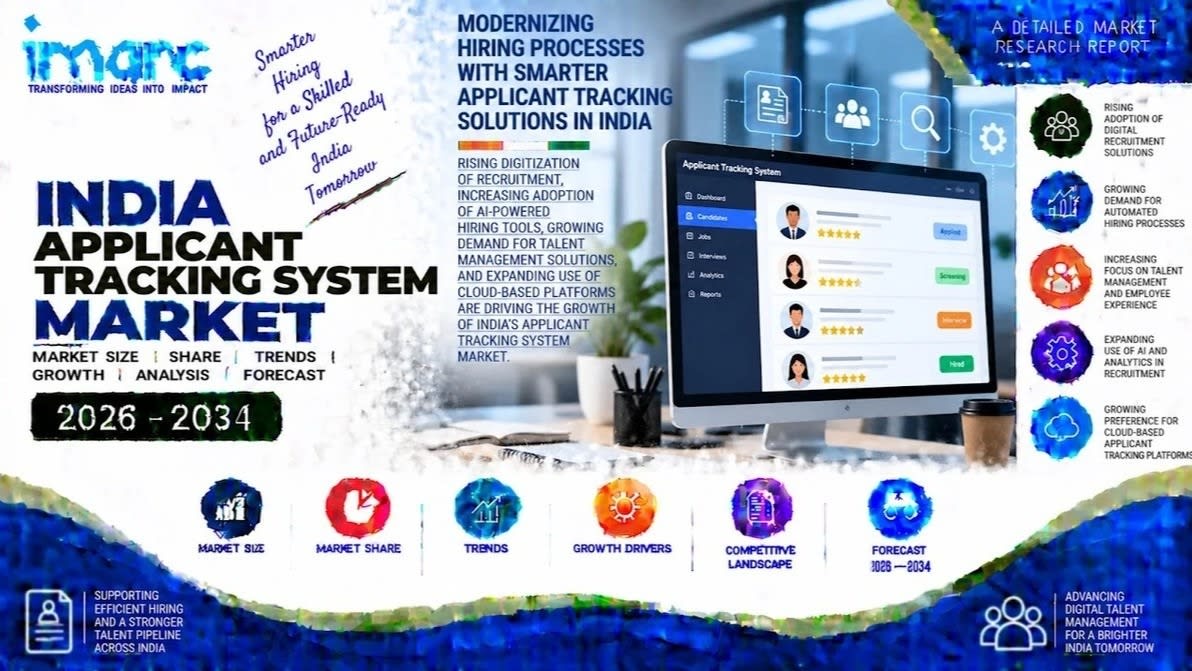
According to IMARC Group’s report titled “India Applicant Tracking System Market Size, Share, Trends and Forecast by Deployment, Organization Size, Component, End-User, and Region, 2026-2034“, the report offers a comprehensive analysis of the industry, including market trends, share, forecast, growth and regional insights. Market Outlook The India applicant tracking system market size reached USD 321.6 Million in 2025. Looking forward, IMARC Group expects the market to reach USD 583.3 Million by 2034, exhibiting a growth rate (CAGR) of 6.63% during 2026-2034. The increasing digital recruitment adoption, AI-driven automation, rising demand for efficient hiring processes, a surge in remote work, integration with advanced analytics and compliance with evolving labor laws are contributing to the market growth. Market Snapshot Market Size (2025): USD 321.6 Million Forecast Market Size (2034): USD 583.3 Million CAGR (2026-2034): 6.63% Base Year: 2025 Forecast Years: 2026-2034 Historical Years: 2020-2025 What are the Key Developments and Emerging Shifts in the India Applicant Tracking System Market? Digital India Skill Initiatives: The National Skill Development Corporation actively modernizes human resource management frameworks across various sectors. By establishing centralized talent registries, this government policy seamlessly facilitates extensive candidate sourcing. Consequently, human resource departments integrate advanced applicant tracking systems to systematically manage these vast talent pools, directly accelerating the domestic adoption of structured digital recruitment architectures. Public Sector Recruitment Digitization: The Ministry of Personnel, Public Grievances and Pensions continuously implements comprehensive e-governance solutions across administrative departments. By migrating traditional civil service recruitment protocols to online digital platforms, the government sets a national standard. This digital transition effectively compels public enterprises to deploy secure applicant tracking systems, standardizing high-volume hiring and accelerating market formalization nationwide. Powered by Personal & Corporate Gifting: Recruitment enterprises increasingly adopt digital and NFC business cards as personal and corporate gifts to modernize networking. Aligned with the Digital India mission, utilizing these smart branded cards for employees and corporate clients enhances professional outreach. This technological transition minimizes paper usage while fostering seamless credential sharing across extensive talent acquisition networks and business ecosystems. Data Privacy Framework Upgrades: The enforcement of the Digital Personal Data Protection Act fundamentally restructures candidate information handling across the corporate sector. By mandating explicit consent and secure data processing mechanisms, the government compels recruitment agencies to upgrade their human resource software. This regulatory compliance ensures that applicant tracking systems integrate robust encryption, enhancing overall recruitment data security significantly. MSME Human Resource Modernization: Through the Digital MSME Scheme, the government provides critical financial assistance to unorganized enterprises for adopting cloud-based enterprise solutions. This vital intervention enables localized manufacturing and service firms to modernize their regional human resource operations. Upgraded digital infrastructure ensures better talent management efficiency, empowering micro-enterprises to utilize scalable applicant tracking software effectively. What Factors are Driving Growth in the India Applicant Tracking System Market? Software Technology Parks Development: The establishment of Software Technology Parks provides robust infrastructural support for expanding information technology enterprises. As global corporate entities expand their operational footprints within these government-backed zones, the requirement for localized mass recruitment rises proportionally. This continuous infrastructural development naturally elevates the procurement of integrated applicant tracking systems to manage complex technical hiring processes efficiently. Startup India Ecosystem Expansion: The Startup India initiative fundamentally accelerates the proliferation of domestic technology ventures through extensive tax exemptions and compliance simplifications. As these emerging enterprises secure capital and scale operations rapidly, their human resource demands increase exponentially. This vibrant entrepreneurial ecosystem acts as a primary catalyst, driving continuous demand for agile, cloud-based applicant tracking platforms nationwide. Foreign Direct Investment Liberalization: Allowing unrestricted foreign direct investment under the automatic route for the information technology sector transforms the industrial landscape. This open investment framework seamlessly attracts substantial global capital and advanced recruitment technologies into the country. The steady influx of international funding rapidly accelerates domestic human resource modernization, enhancing widespread adoption of intelligent applicant tracking systems. E-Governance Portal Integration: The National Career Service portal systematically bridges the gap between domestic job seekers and corporate employers. By integrating advanced API frameworks, the government encourages private enterprises to seamlessly synchronize their internal hiring software with public databases. This strategic digital integration significantly broadens the domestic talent pool accessible through commercial applicant tracking systems, multiplying overall operational utility. Manufacturing Capacity Augmentation: The Production Linked Incentive scheme across various manufacturing sectors stimulates massive industrial expansion and localized capacity building. As domestic factories scale their operations to meet production targets, the urgent need for structured blue-collar workforce recruitment intensifies. This robust manufacturing growth directly drives industrial conglomerates to procure specialized applicant tracking systems to streamline high-volume workforce acquisition. ➤ Request Sample Report – TOC, Charts & Key Insights: https://www.imarcgroup.com/india-applicant-tracking-system-market/requestsample How Is the Market Segmented? Deployment Insights: On-premises Cloud Organization Size Insights: Small and Medium-sized Enterprises Large Enterprises Component Insights: Software Services End-User Insights: BFSI IT and Telecommunications Government and Public Sector Retail Manufacturing Healthcare and Life Sciences Others Regional Insights: North India South India East India West India Recent Market Developments The Ministry of Electronics and Information Technology strictly implemented the Digital Personal Data Protection Act, legally mandating superior candidate data security protocols to systematically accelerate secure enterprise applicant tracking systems. The Ministry of Skill Development aggressively expanded Skill India Digital integrations, securing massive verified talent pools that heavily boost automated recruitment efficiencies. DPIIT accelerated SaaS capital subsidies, localizing domestic HR-tech innovation continually. Competitive Landscape The market features intensely competitive activity strictly focused on rapid capacity expansion, compliance with rigid national environmental safety frameworks, and seamless integration with formalized automotive supply chains. A massive strategic focus remains on heavily leveraging advanced localized hydrometallurgical processing to cater to the rapidly evolving material requirements of newly sanctioned domestic gigafactories. According to IMARC Group, key players driving the India battery recycling market include: Customization Note: If you require any specific information not covered within this report's scope, we will provide it as part of the customization. ➤ Request Report Customization: https://www.imarcgroup.com/request?type=report&id=32504&flag=E Frequently Asked Questions (FAQs) 1. How big is the India applicant tracking system market? According to IMARC Group, the India applicant tracking system market size reached USD 321.6 Million in 2025. 2. What is the expected market growth by 2034? IMARC Group expects the market to reach USD 583.3 Million by 2034, exhibiting a CAGR of 6.63% during 2026-2034. 3. What factors are driving the India applicant tracking system market? IMARC Group identifies increasing digital recruitment adoption, AI-driven automation, and a surge in remote work as primary growth drivers. 4. Which deployment model holds the largest market share? According to IMARC Group, cloud-based deployment dominates the market, reflecting enterprise preference for highly scalable SaaS delivery models. 5. Which organization size segment leads the demand? IMARC Group states that large enterprises capture the majority share due to their complex, multi-location hiring requirements and workforce planning needs. Strategic Insight & Verdict The India applicant tracking system market is executing a massive structural expansion fundamentally engineered by the DPDP Act and Digital India mandates. As the government rigorously enforces data localization and subsidizes domestic HR-tech through Startup India, reliance on unsecure manual hiring processes is permanently vanishing. For corporate stakeholders, state-backed digital talent formalization successfully secures a permanently optimized environment for advanced recruitment software investments.