
India Household Cleaners Market Size, Share, Emerging Trends and Analysis Report 2026-2034
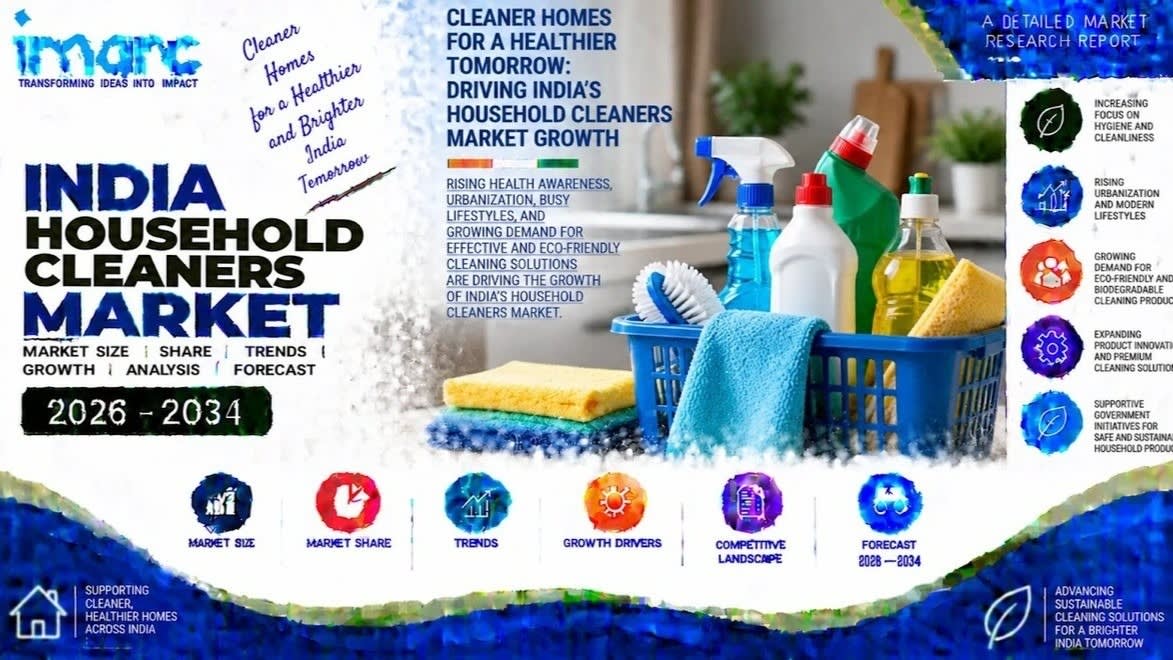
According to IMARC Group’s report titled “India Household Cleaners Market Size, Share, Trends and Forecast by Product, Ingredients, Distribution Channel, Income Group, Application, Premiumization, and Region, 2026-2034“, the report offers a comprehensive analysis of the industry, including market trends, share, forecast, growth and regional insights. Market Quick Facts Market Size in 2025: USD 11.91 Billion Market Size in 2026: USD 14.04 Billion Expected Size by 2034: USD 39.84 Billion Compound Annual Growth Rate (CAGR): 13.93% (2026-2034) Leading Region: North India (45.2% Share) Leading Product: Laundry (60.7% Share) Leading Ingredient: Builders (41.8% Share) Industry Overview The India household cleaners industry reach USD 11.91 Billion in 2025 to USD 14.04 Billion in 2026 and is projected to reach USD 39.84 Billion by 2034, growing at a CAGR of 13.93% during 2026-2034. The ecosystem integrates chemical suppliers and product manufacturers with expanding organized retail and direct-to-consumer distribution networks. Sustained urban household formation and increasing washing machine penetration are accelerating demand for specialized, premium formulations across fabric and surface care. Concurrently, the rapid proliferation of e-commerce platforms is improving product accessibility across diverse regions, establishing a highly resilient environment for long-term category expansion despite persistent pricing pressures from the unorganized sector and raw material volatility. Market Segmentation Breakdown By Product The market is segmented into laundry, dishwashing, surface cleaner, toilet bowl cleaner, glass cleaner, window cleaner, scourers, and others. Leading Segment: Laundry held a 60.7% share in 2025. This segment's dominance reflects daily-use frequency, universal household requirement, and the expanding portfolio of machine-wash detergent subcategories driven by appliance penetration. By Ingredients The market is segmented into builders, surfactants, solvents, antimicrobials, and others. Leading Segment: Builders held a 41.8% share in 2025. Builders dominate the ingredients segment as they are indispensable for enhancing detergent performance by sequestering calcium and magnesium ions, softening water hardness, and improving overall cleaning efficacy across laundry powders and dishwashing products. By Distribution Channel The market is segmented into supermarkets, kirana stores, e-commerce platforms, and wholesale distributors. Leading Segment: Supermarkets/Hypermarkets accounted for a 60.1% share in 2025. By Income Group The market is segmented across different consumer income levels. Leading Segment: Middle (INR 2.5 lacs- INR 27.5 lacs) represented a 57.0% share in 2025. By Application The market is segmented into fabric, kitchen, bathroom, floor, and others. Leading Segment: Fabric held a 60.7% share in 2025. By Premiumization The market is segmented into economy, mid-size, and premium categories. Leading Segment: Economy accounted for a 54.5% share in 2025. By Region The market is geographically segmented into North India, South India, West and Central India, and East India. Leading Segment: North India led with a 45.2% share in 2025. North India leads through its high population density, the largest concentration of urban consumption centers, and robust organized retail infrastructure that supports both economy and premium household cleaner penetration across all income segments. ➤ Request Sample Report – TOC, Charts & Key Insights: https://www.imarcgroup.com/india-household-cleaners-market/requestsample What are the Key Developments and Emerging Shifts in the India Household Cleaners Market? Swachh Bharat Mission Integration: The Swachh Bharat Abhiyan continually elevates national sanitation standards, mandating comprehensive cleanliness protocols across urban and rural municipalities. This flagship government initiative directly drives widespread public awareness regarding household hygiene. Consequently, the mandate accelerates continuous domestic demand for essential cleaning chemicals, systematically expanding the organized household cleaners manufacturing sector nationwide. Chemical Safety Standard Upgrades: The Bureau of Indian Standards consistently revises safety protocols for domestic chemical manufacturing. By restricting toxic volatile organic compounds, this regulatory framework ensures consumer safety. Consequently, household cleaner manufacturers are rapidly shifting toward producing non-toxic, eco-friendly formulations, aligning their product portfolios with modern public health mandates and stringent quality benchmarks. Micro Enterprise Modernization: Through the PMFME scheme, the government empowers unorganized cleaning product micro-enterprises by providing essential seed capital. This vital financial intervention enables local formulation units to upgrade their specialized mixing and bottling infrastructure. Upgraded regional facilities experience enhanced operational efficiency, contributing directly to broader national market expansion and industry formalization. Powered by Personal & Corporate Gifting: Household cleaner enterprises increasingly adopt digital and NFC business cards as personal and corporate gifts to modernize networking. Aligned with the Digital India mission, utilizing these smart branded cards for employees and distributors enhances professional outreach. This technological transition minimizes paper usage while fostering seamless credential sharing across retail networks. Plastic Waste Management Rules: The implementation of stringent Plastic Waste Management Rules compels manufacturers to adopt sustainable packaging. By enforcing extended producer responsibility, the government encourages the transition from virgin plastics to recycled polymers for cleaner bottles. This regulatory framework promotes eco-friendly manufacturing practices, aligning the cleaning products industry with national sustainability targets. What Factors are Driving Growth in the India Household Cleaners Market? Rural Sanitation Infrastructure: The Jal Jeevan Mission accelerates the provision of piped water connections to rural households, fundamentally upgrading domestic living standards. With improved access to continuous water supply, rural populations are increasingly adopting modern wet-cleaning methods. This infrastructural development acts as a primary catalyst, driving substantial new demand for liquid surface cleaners. Vocal for Local Campaign: The Aatmanirbhar Bharat initiative strongly encourages domestic consumers to prioritize locally manufactured household goods. By launching targeted awareness campaigns and supporting regional artisans, the government shifts purchasing preferences away from imported cleaning products. This strategic nationalist policy directly benefits indigenous detergent and cleaner producers, accelerating localized manufacturing volumes across states. Urban Housing Expansion: The Pradhan Mantri Awas Yojana drives the rapid construction of affordable residential housing across metropolitan regions. Because every newly occupied household necessitates essential sanitation supplies, this extensive infrastructure scheme creates a vast consumer base. The steady expansion of urban settlements fundamentally ensures sustained retail consumption of durable cleaning chemical formulations. E-Commerce Marketplace Integration: The Open Network for Digital Commerce initiative revolutionizes retail distribution by digitally integrating local household goods manufacturers. This government-backed framework allows regional surface cleaner producers to access broader urban markets without relying on traditional intermediaries. Enhanced digital visibility empowers small-scale manufacturers to seamlessly scale their sales volumes and operational profitability. Women Empowerment Schemes: The Deendayal Antyodaya Yojana systematically empowers rural women by integrating them into organized self-help groups. These government-backed collectives frequently engage in the commercial production of traditional household cleaners. By providing institutional credit and regional market linkages, the policy drives sustainable income generation, significantly scaling the total output of indigenous cleaning supplies. Leading Companies The India household cleaners market is moderately concentrated and characterized by competitive engagement between multinational FMCG corporations and strong domestic manufacturers. Key players are aggressively expanding manufacturing capacities, advancing sustainable and eco-friendly formulation innovations, and establishing direct-to-consumer digital infrastructure to capture urban market growth while leveraging economy SKUs for rural penetration. Unilever Procter & Gamble Jyothy Laboratories Ltd. Nirma Note: If you need specific information that is not currently within the scope of the report, we can provide it to you as a part of the customization. ➤ Request Report Customization: https://www.imarcgroup.com/request?type=report&id=5001&flag=E Frequently Asked Questions (FAQs) 1. How big is the India household cleaners market? According to IMARC Group, the India household cleaners market size reached USD 11.91 Billion in 2025. 2. What is the expected market growth by 2034? IMARC Group expects the market to reach USD 39.84 Billion by 2034, exhibiting a CAGR of 13.93%. 3. Which product dominates the domestic market? According to IMARC Group, the laundry segment holds the leading position with a 60.7% market share in 2025. 4. Which distribution channel leads the demand? IMARC Group states that supermarkets and hypermarkets capture the largest distribution share at 60.1% in 2025. 5. Which region holds the largest market share? According to IMARC Group, North India represents the largest regional market, commanding a 45.2% share in 2025. Strategic Insight & Verdict: The structural consolidation of India’s home care and cleaning retail space marks an exceptional window for high-volume institutional consolidation. As consumer purchasing patterns permanently pivot away from generic, unbranded chemical commodities toward clinically validated, eco-certified, and value-added household care solutions, we at IMARC Group have observed that the highest financial returns will belong to enterprise investors who secure control over advanced plant-based surfactant inputs and deploy direct integration links with expanding quick-commerce hyper-local distribution chains. Moving forward, the strategic deployment of FMCG capital must prioritize ingredient transparency, packaging automation, and localized builder scaling to capture maximum long-term equity across the expanding domestic consumer economy.