
Shop-Along Research: Understanding Shopper Behaviour at the Point of Purchase
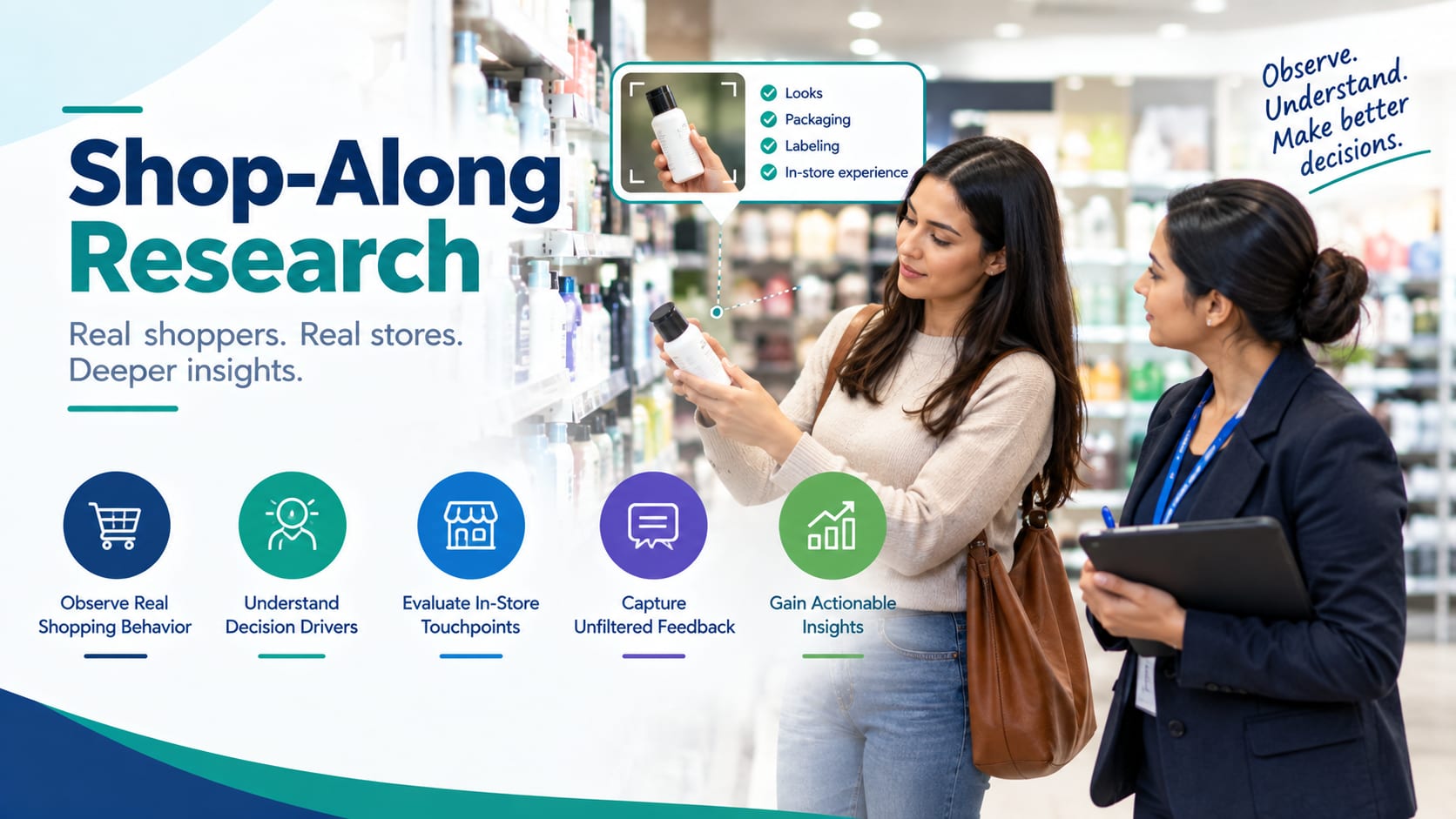
Understanding why consumers choose one product over another is essential for businesses looking to improve their products, retail strategies, and customer experiences. While surveys can reveal what shoppers say they prefer, observing their decisions in a real shopping environment can uncover details that are difficult to capture through questionnaires alone. Shop-Along Research helps businesses understand these decisions by studying shoppers as they navigate stores, evaluate products, compare alternatives, and make purchasing choices. Through direct observation and guided conversations, researchers can explore how consumers interact with products, interpret packaging, respond to promotions, and navigate retail environments. This approach provides valuable context about the factors that influence purchasing behaviour and the challenges shoppers encounter during their journeys. For brands, retailers, and consumer-focused organizations, shop-along research offers a practical way to connect consumer perspectives with real-world shopping experiences. Shop-Along Research
What Is Shop-Along Research?
Shop-Along Research is a qualitative research method in which a researcher accompanies a participant during a shopping trip to observe their behaviour and understand the reasoning behind their decisions. Depending on the study objectives, participants may shop for groceries, personal care products, household goods, electronics, apparel, or other categories. The researcher observes how participants navigate the store, locate products, compare options, read labels, and respond to different retail elements. Guided questions may be asked during or after the shopping experience to explore the participant's thoughts, preferences, and decision-making process. Unlike research conducted only through interviews or surveys, shop-along research captures behaviour in the context where purchasing decisions actually occur. It helps researchers understand not just what shoppers choose, but also the considerations and experiences that influence those choices.
Why Are Shop-Along Research Services Important?
Purchasing decisions are influenced by several interconnected factors, including product availability, packaging, pricing, promotions, brand familiarity, and the shopping environment. Shop-Along Research Services help organizations examine these factors as shoppers encounter them in real retail settings.
- 1. Understand Actual Shopper Behaviour
- Consumers may not always remember every detail of their shopping experience when answering a survey. They may also find it difficult to explain unconscious habits or small decisions that influence their choices.
- Direct observation helps researchers identify behaviours such as checking prices, comparing product sizes, switching brands, revisiting shelves, or seeking additional information.
- These observations provide context that can help explain how shoppers make decisions.
- 2. Identify Purchase Drivers and Barriers
- A shopper may select a product because of its price, packaging, perceived quality, convenience, or familiarity. Alternatively, unclear product information, poor shelf visibility, or difficulty comparing alternatives may discourage a purchase.
- Shop-along research helps identify these influences by examining what happens during the shopping journey.
- Businesses can use the findings to understand which product attributes attract attention and which obstacles may prevent shoppers from choosing a particular offering.
- 3. Evaluate In-Store Product Presentation
- The way products are displayed can influence whether shoppers notice and consider them.
- Researchers can observe how participants respond to shelf placement, packaging, signage, promotional displays, and product organization.
- These findings can help brands and retailers assess whether their products are easy to locate, understand, and compare within the retail environment.
- 4. Improve the Shopping Experience
- A complicated or confusing shopping experience may create frustration and affect purchasing decisions.
- Shop-along research can reveal practical difficulties, such as trouble locating a product, understanding packaging information, comparing product variants, or navigating store sections.
- Identifying these issues helps businesses explore ways to make shopping journeys clearer and more convenient.
- 5. Support Product and Marketing Decisions
- Observations from real shopping environments can inform product development, packaging improvements, promotional strategies, and retail execution.
- For example, if participants repeatedly struggle to distinguish between similar product variants, a business may investigate clearer packaging or product communication.
- The research provides evidence to guide potential improvements rather than relying entirely on assumptions about shopper preferences.
Key Areas Covered by Shopper Research
- Shopper Research can examine different aspects of the purchasing journey, depending on the category, retail environment, and business questions being investigated.
- Purchase Decision Research
- Purchase Decision Research focuses on the factors that influence whether shoppers select a particular product.
- Researchers may explore price comparisons, brand preferences, product features, promotional offers, and perceived value. They can also investigate the moments when shoppers change their minds or move from considering a product to purchasing it.
- Understanding these decisions helps businesses identify the attributes that matter most to their target audiences.
- In-Store Research
- In-Store Research examines how consumers interact with the physical retail environment.
- It may cover product visibility, shelf navigation, store layout, signage, promotions, and the availability of relevant product information.
- Observing shoppers as they move through a store helps researchers understand how the environment supports or complicates their purchasing journeys.
- Shopper Behavior Research
- Shopper Behavior Research investigates the habits, preferences, and decision-making patterns that shape shopping experiences.
- It can examine how consumers plan purchases, compare products, respond to promotions, and balance factors such as price, convenience, quality, and brand familiarity.
- These insights can help businesses understand differences between shopper groups and identify opportunities to improve product positioning or retail strategies.
- Product and Packaging Evaluation
- Shop-along research can help organizations understand how shoppers interpret packaging and product information while making decisions.
- Researchers may observe whether participants notice important product attributes, understand instructions, distinguish between variants, or find the information needed to compare alternatives.
- The findings can inform decisions about packaging clarity, product communication, and shelf presentation.
- Brand Switching and Product Selection
- Shoppers sometimes switch brands because of price changes, product availability, promotions, or dissatisfaction with their usual choice.
- Observing these decisions can help researchers investigate the circumstances that encourage shoppers to reconsider familiar products.
- This information may help businesses understand opportunities to attract new customers or improve the appeal of existing offerings.
How Does Accompanied Shopping Research Work?
- Accompanied Shopping Research follows a structured process designed to capture shopper behaviour while allowing participants to explain their decisions.
- Step 1: Define the Research Objectives
- The study begins by identifying the questions the business needs to answer.
- Objectives may include understanding product selection, evaluating packaging, investigating brand switching, or exploring difficulties within the shopping journey.
- Clear objectives help researchers determine which behaviours and interactions require attention.
- Step 2: Select the Right Participants
- Participants should reflect the target audience relevant to the research question.
- Depending on the study, selection criteria may include product usage, shopping frequency, purchase responsibility, category preferences, or experience with specific retail formats.
- Appropriate participant recruitment helps ensure that the research captures relevant shopping experiences.
- Step 3: Choose the Shopping Environment
- The retail setting should align with the research objectives.
- For example, a study about grocery purchasing may require a supermarket, while research into electronics purchasing may be more suitable for a specialist retailer.
- The chosen environment should provide opportunities to observe the behaviours and decisions the study aims to understand.
- Step 4: Conduct the Accompanied Shopping Session
- The researcher accompanies the participant during the shopping activity, observing relevant behaviours and asking suitable questions.
- Participants may be encouraged to explain what attracts their attention, why they compare certain products, or what information influences their choices.
- The researcher should avoid unnecessarily directing the participant's decisions so that the session reflects their natural shopping behaviour as closely as possible.
- Step 5: Record Observations and Participant Feedback
- Researchers document relevant actions, comments, product interactions, and difficulties encountered during the shopping journey.
- Depending on the study design and permissions, this may involve written notes or other agreed recording methods.
- Combining observations with participant explanations helps provide a more complete picture of the decision-making process.
- Step 6: Analyse Shopper Insights
- The collected information is reviewed to identify recurring behaviours, common decision drivers, differences between participants, and potential barriers to purchase.
- Researchers may compare shopping experiences across audience groups or product categories to identify meaningful patterns.
- Step 7: Translate Findings Into Practical Recommendations
- The final stage connects the findings to business priorities.
- Recommendations may relate to packaging design, product information, shelf organization, promotional communication, or other aspects of the shopping experience.
- The objective is to turn observed behaviour into useful information that supports decision-making.
Common Challenges in Shop-Along Research
Although shop-along research provides valuable context, its effectiveness depends on careful study design and appropriate execution.
- Observer influence: Participants may behave differently when accompanied by a researcher. Neutral questioning and a comfortable research environment can help reduce unnecessary influence.
- Limited participant coverage: Qualitative shop-along studies typically involve fewer participants than large-scale surveys. Their findings provide depth and context but should not automatically be treated as representative of an entire market.
- Environmental distractions: Crowded stores, interruptions, product availability, and changing retail conditions can affect shopping sessions. Researchers should account for these factors when interpreting observations.
- Difficulty explaining behaviour: Participants may not always be able to articulate why they made a particular decision. Observing their actions alongside their comments can help researchers develop a more complete interpretation.
- Inconsistent observations: Different researchers may focus on different details unless the study uses clear observation guidelines. Structured research frameworks help maintain consistency.
- Privacy and permissions: Conducting research in retail settings may involve store policies, participant consent, and restrictions on recording. These requirements should be addressed before fieldwork begins.
- Recognizing these challenges helps researchers design studies that produce more useful and carefully interpreted findings.
How to Choose the Right Shop-Along Research Services Provider
- Selecting an appropriate research partner can influence the quality and relevance of the findings.
- When evaluating Shop-Along Research Services providers, businesses should consider the following factors:
- Research design: Assess whether the provider can develop a study aligned with the specific shopping behaviours and decisions being investigated.
- Participant recruitment: Understand how shoppers will be selected according to the study's target audience and eligibility criteria.
- Qualitative research experience: Look for an approach that combines careful observation with effective questioning and interpretation.
- Fieldwork quality: Review how observations are documented, how sessions are managed, and how consistency is maintained.
- Geographic and retail coverage: Consider whether the provider can support the required markets, store formats, and participant profiles.
- Reporting and recommendations: Ensure the final findings connect observed behaviours with the business questions that prompted the study.
- The right provider should be able to translate real-world shopping observations into structured insights that help businesses understand their customers more effectively.
How IMARC Pulse Supports Shopper Research
IMARC Pulse specializes in primary research and global fieldwork, helping organizations connect with the people who shape their markets. Its services include respondent recruitment, quantitative and qualitative fieldwork, data collection, and research quality services across industries and global markets. Its research approach combines rigorous fieldwork and verified data to deliver reliable insights that support informed business decisions. These capabilities provide a foundation for primary research projects that require appropriate respondent recruitment, structured data collection, and quality-focused fieldwork. For shopper-focused studies, clear research objectives and suitable participant selection are important for gathering information relevant to purchasing behaviour and retail experiences. Businesses seeking to understand shoppers more deeply can use a structured research approach to investigate customer perspectives and identify questions that merit further analysis.
Conclusion
Shop-Along Research helps businesses understand consumer behaviour in the environment where many purchasing decisions take place. By observing shoppers as they navigate stores, compare products, evaluate prices, and make selections, organizations can gain valuable context about the factors influencing their choices. Through Shop-Along Research Services, businesses can investigate purchase drivers, assess product presentation, identify shopping barriers, and better understand the relationship between retail environments and consumer decisions. Combining direct observation with guided conversations allows researchers to explore both what shoppers do and why they make particular choices. When supported by clear objectives, suitable participant recruitment, and careful analysis, shop-along research can provide useful insights for improving products, retail strategies, and shopping experiences. IMARC Pulse